Case Study: The Client Who Found Me Through AI — Then Hired a Human
Overview
OmniJet — Omni International Jet Trading — has brokered business jets since 1963. Three generations of the Hilmer family, more than 3,000 aircraft transacted across four continents, and a client roster that has included Frank Sinatra, Elvis Presley, and Ross Perot. In an industry that runs on trust, OmniJet had six decades of it banked.
Their website told none of that story. The site ran on a single physical server in the company office — “we are literally one server in a box,” as VP Ben Hilmer put it — with content edited in a desktop publishing tool and pushed live by dragging files across, the way the web worked twenty-five years ago.
Here’s the part that makes this project a sign of the times: Ben found me through Claude AI while researching web design firms with aviation experience. He’s an AI-fluent operator — he uses Claude for contract work, builds his own interactive data tools with it, and his team had already experimented with AI-generated web pages before we ever spoke. They’d seen what AI alone could produce. They hired a human anyway.
Fifteen weeks after kickoff, the new omnijet.com launched. The CEO’s reaction to the design work, relayed by Ben mid-project, is the quote I’ll be carrying around for a while:
“I can’t tell you how excited the team is for this website… Even my dad’s getting stoked now too, because I sent him some of the mockups. He’s like, ‘Yeah, this is better than Claude.’”
— Ben Hilmer, VP, OmniJet (relaying CEO Wayne Hilmer Jr.’s reaction)
- Client: Omni International Jet Trading, Inc. (OmniJet)
- Sector: Aviation — Private Jet Brokerage & Acquisitions
- Services: Content strategy, UX & information architecture, web design, JAMstack development, CMS configuration & training, CRM integration
- Platform: Hugo (JAMstack) · Netlify global CDN · Decap CMS · GitHub · Vimeo · Close CRM via Netlify Functions
- Timeline: Kickoff mid-April 2026 → launched July 28, 2026
The Challenge: Sixty-Three Years of Trust, Zero of It Online
OmniJet’s buyers are high-net-worth individuals and flight departments making seven- and eight-figure decisions. Every one of them checks the website — even the ones who already have Ben’s cell number. What they found was a relic:
- A single point of failure. The entire web presence lived on one server in an Eastern Maryland office. A power outage took the site down. A European prospect got European-server-in-Maryland load times.
- Content was locked away. Updates required a desktop publishing tool and manual file transfers. The Head of Marketing, Jenn Buchanan, had been advocating for a new website for over five years.
- The AI experiments got them partway — and stalled. The team had generated pages with Claude, including a data-rich operating-cost page. The information was there; the brand, cohesion, and conversion architecture were not. At kickoff, one of our first decisions was to retire the AI-generated homepage direction in favor of custom, brand-forward design.
- The story wasn’t being told. Frank Sinatra bought jets from this family. That heritage — the single most differentiating asset a trust-based brokerage owns — appeared nowhere.
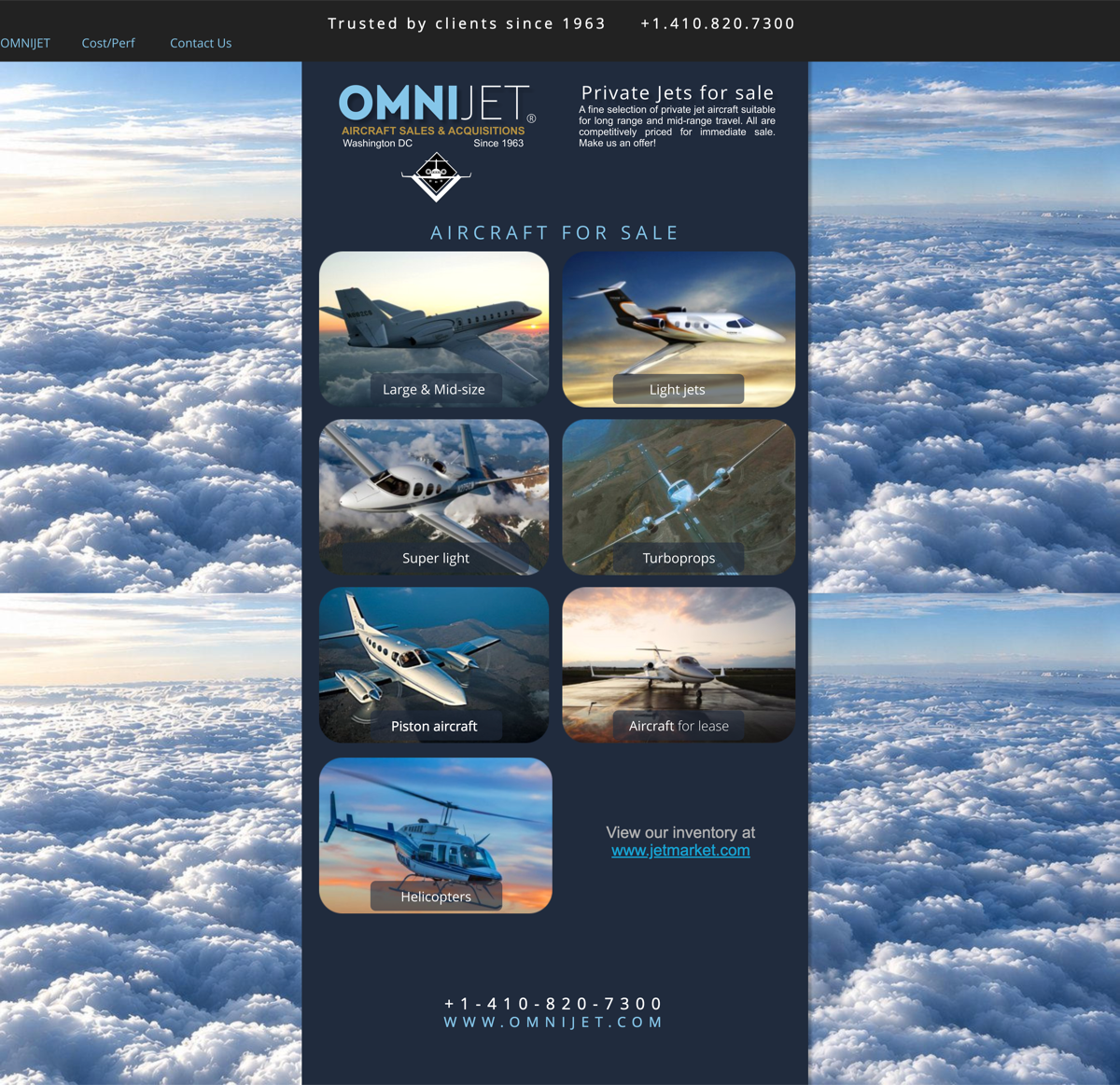
The old omnijet.com: a fixed-width relic on a tiled cloud background — served, until July 2026, from one physical server in the company office.
The Objective
✅ Replace the server-in-a-closet with modern, globally distributed, client-owned infrastructure
✅ Design a cinematic, luxury-grade experience worthy of the demographic — without sacrificing conversion fundamentals
✅ Put the aircraft inventory, and the brokers behind it, one low-friction click from every visitor
✅ Hand the OmniJet team full self-serve control of listings and content — no developer required
✅ Weave sixty-three years of heritage into every page
The Solution: Expertise Leading, AI Amplifying
Phase 1: Information Architecture Built Around How Jets Actually Sell
Before any design, I delivered a complete content strategy and information architecture — built from competitive analysis of the brokerage landscape and refined line-by-line with Ben on working calls. Brokerage drives roughly 70% of OmniJet’s business, so the architecture leads with it: primary CTAs locked to “Browse Aircraft” and “Begin Your Sale,” a consolidated acquisition/sales inquiry path, and a Resources hub of market reports and operating-cost data that builds search authority between listings. The heritage — Sinatra, Elvis, three generations — became a credibility layer running through the whole site.
This is where collaboration with a sharp client gets fun. Ben pressure-tested every recommendation, and when the data said his instinct would hurt conversion — like section-by-section full-screen video that traps users — I showed him why:
“Okay, now I see that — and that’s why you’re the professional.”
— Ben Hilmer
Phase 2: Design in Real Time, Not Message-in-a-Bottle
My design process is live. Instead of emailing static comps into the void and waiting a week for feedback, Ben and I worked screen-to-screen: exploring typefaces together in real time, swapping hero imagery, tuning the balance between cinematic drama and readable, accessible structure. The result was a luxury editorial aesthetic — full-viewport hero video, understated serif typography, the brand’s legacy blue — that still respects every conversion and accessibility fundamental the flashy sites ignore.
“It’s interesting — I’ve never seen the process like this, so it’s actually pretty cool.”
— Ben Hilmer
Two calls later, the homepage direction was approved and the mockups were circulating internally at OmniJet — where the skeptical, old-school generation signed off in the most 2026 way possible: better than Claude.
“Going through this, dude — I know I picked the right guy.”
— Ben Hilmer
Phase 3: A JAMstack Build the Client Actually Owns
I developed the site on Hugo, deployed to Netlify’s global CDN — the same infrastructure I use for clients in politics and finance where downtime isn’t an option. No plugins to exploit, no database to hack, no more server in a box. The full codebase lives in the client’s GitHub; they could pack up and move hosts in five minutes if they ever wanted to. That ownership was a deciding factor for a second-generation CEO who’d run his own server for decades precisely because he never wanted to be locked into someone else’s walled garden.
The build itself is purpose-made for jet brokerage:
- Filterable aircraft inventory with detailed listing pages, spec sheets, and downloadable brochures — managed entirely through the CMS with featured and inactive toggles, so the team curates the homepage without touching code.
- Broker-routed inquiry forms — a dropdown connects each serious buyer directly to the right team member, with every submission simultaneously creating a lead in Close CRM via a custom Netlify Function.
- Cinematic Getty video across hero sections, Vimeo-optimized so the luxury feel never costs load time.
- Six languages, fully search-indexed, for a clientele that spans four continents.
Phase 4: Making the Client’s AI Better — Not Fighting It
Ben builds interactive tools with Claude — an operating-cost calculator, an aircraft performance comparison tool. Instead of treating that as a threat, I built it into the system: I restructured his AI-generated tools to match the site’s design language, then set up a workflow where Ben regenerates them with Claude whenever the data changes and uploads through the CMS. No developer bottleneck, no brand drift.
That’s the model I believe in: AI multiplies expertise — it doesn’t replace it. The client’s AI fluency plus my design, strategy, and engineering judgment produced something neither could have shipped alone. Their own CEO said as much.
The Results: Launched, Adopted, and Paid in Full — With the Team Running It
The new omnijet.com went live July 28, 2026 — coordinated DNS cutover with the same founder who’d been hand-managing the old server since the beginning. Ben’s father saw the finished site before launch and was, in Ben’s words, “blown away.”
This is a fresh launch, so the performance chapter is still being written — Google Analytics went in configured with conversion tracking from day one (not retrofitted later), so the data story will be told properly. What’s already banked:
✅ The verdict that matters in 2026: an AI-fluent client who found me through Claude, tried AI-generated pages first, and concluded the expert-led result was “better than Claude.”
✅ A five-year internal campaign, resolved: the marketing lead who’d pushed for a new site for half a decade now runs it day-to-day through a fill-in-the-blank CMS — trained, credentialed, and self-sufficient from week one.
✅ From one server in a box to a global CDN: ~99.9% uptime, edge-distributed worldwide, every change version-controlled and backed up in the client’s own GitHub.
✅ Leads that route themselves: inquiry forms feed the right broker and the CRM automatically — no more inbox triage.
✅ Staged, reviewed, approved, and settled: 30% deposit up front, 70% due only on satisfaction. Final invoice was requested by the client — with a thank-you — and paid in full within the week.
In Ben’s own words, across the engagement:
“Very excited to have you as my partner in reimagining our website and brand.”
“Wow…. What an incredible site!”
“It’s going to be the best in the business, I think… Outstanding job.”
— Ben Hilmer, Vice President, OmniJet
Frequently Asked Questions
Why didn’t OmniJet just build the site with AI?
They tried — the team generated pages with Claude before hiring me, and Ben remains a power user. What AI alone couldn’t deliver was the judgment layer: brand cohesion, conversion architecture, accessibility, competitive positioning, and a design process that pressure-tests instincts against data. The finished site actually incorporates the client’s AI-built tools — restructured to match the design system — which is the point: AI amplifies expertise rather than replacing it.
What platform is the OmniJet website built on?
Hugo (JAMstack) deployed to Netlify’s global CDN, with Decap CMS for fill-in-the-blank content editing, GitHub version control, Vimeo-optimized background video, and a custom Netlify Function that routes every inquiry to the selected broker while creating the lead in Close CRM. No page builders, no plugins, no database to exploit.
Can the OmniJet team update the site themselves?
Entirely. Aircraft listings, team bios, market reports, photos, and video are all managed through the CMS — including featured/inactive toggles that control homepage curation. I trained the VP, the Head of Marketing, and the CEO, and the team took over day-to-day content before launch week was out.
How long did the project take?
About fifteen weeks from kickoff to launch: information architecture and content strategy first, then collaborative real-time design reviews, then a two-to-three-week development sprint, CMS training, and a coordinated DNS cutover.
Has Your Reputation Outgrown Your Website?
If your business has decades of trust that your web presence doesn’t reflect — or you’ve tested what AI alone can build and felt the gap — let’s talk about what expertise-led design does differently.