Case Study: Ten Years in Business, Zero Web Presence — Building MWDT’s Brand From the Mark Up
Overview
MWD Technologies — MWDT — is a Texas manufacturing partner that takes industrial components from prototype to production: 5-axis CNC machining with cobot automation, sheet metal fabrication, and ceramic injection molding, backed by in-house engineering and materials expertise. Their customers are engineers and procurement teams at semiconductor fabs, aerospace programs, medical device makers, oil and gas operators, and food and pharmaceutical processors.
After a decade in business, MWDT had never had a website. Two earlier attempts had been abandoned. When co-owner Chris Charles first reached out, he was planning to commission a PDF brochure to support an email campaign for a new fuel cell substrate product.
By the end of the discovery call, the brochure was off the table and the plan was a brand and a website built to grow with them — “begin with the end in mind,” as Chris put it. Ten months later, mwdtinc.com launched with a new MWDT logo, 29 SEO-structured pages across three growth-ready content collections, and a homepage built around a scroll-driven 3D rotating part.
“I reviewed the home page and the structure and content density look great. You have covered all of the bases. This really communicates our capabilities.”
— Chris Charles, Co-Owner, MWD Technologies
- Client: MWD Technologies, Inc. (MWDT)
- Sector: Industrial Manufacturing — Precision Fabrication & Advanced Materials
- Services: Brand identity (MWDT logo + sister-brand mark), content strategy & SEO information architecture, web design, JAMstack development, CMS configuration, email infrastructure & campaign consulting
- Platform: Hugo (JAMstack) · Netlify CDN · Decap CMS · GitHub · GSAP ScrollTrigger · Basin forms · Google Workspace
- Timeline: Discovery November 2025 → product landing page live February 2026 → full site launched September 5, 2026
The Challenge: A Strategic Manufacturer With Nothing to Point To
Chris brings an engineering background and years running his own machine shop; his co-owner brings supply chain management and an MBA. Together they were pushing into higher-value verticals — semiconductor, aerospace, medical — where every buyer checks the website before returning a call.
- No digital footprint at all. Ten years of relationships, zero pages to send a prospect. The first impression was a PDF or nothing.
- A product launch that couldn’t wait. A new fuel cell substrate tube offering had a 125-contact outreach campaign ready to go, and nowhere to send the clicks.
- Eleven industries, nine materials, three capabilities — and counting. The business strategy was vertical-market expansion. A static five-page site would be obsolete the moment they added a market.
- An audience that punishes fluff. As Chris told me, the readers are “90% engineers” plus procurement — people who want specs, tolerances, and material grades, not marketing copy.
- Email infrastructure from scratch. No business email, no sending domain, no deliverability setup — and a mass campaign about to go out from it.
The Objective
✅ Establish a brand mark and visual system that reads as trustworthy, precise, and high-tech to engineers and procurement
✅ Get a campaign-ready landing page and email infrastructure live in weeks, not months
✅ Architect the full site so new industries, materials, and capabilities can be added by the client without a developer
✅ Write and structure content that ranks for the industrial searches MWDT’s buyers actually run
✅ Deliver a homepage that makes a first impression worthy of a company that machines turbine components
The Solution: Marketing First, Then the Brand, Then the Machine Behind It
Phase 1: Discovery That Reframed the Ask
Chris came to the first call expecting to talk about a brochure. I walked through how a website built on the right architecture becomes the source of truth every other asset flows from — the PDF, the email campaign, the trade show one-pager — and why a small custom site that grows one landing page at a time beats a big site that ages all at once.
“I thought we were going to be talking about a PDF brochure, but this is what we need. You know, we need to begin with the end in mind.”
— Chris Charles, Co-Owner, MWD Technologies
Phase 2: Information Architecture as a Working Document
Instead of a discovery questionnaire, I opened a shared Google Doc with two tabs — one for the MWDT site, one for the sister brand — and built the information architecture live with the client inside it. Every page got a hero, a “What We Do” summary, card grids, and image-pairing notes, so the owners could see exactly where each fact they supplied would land.
“This is exactly what I need, because there’s just too much. There’s no way you would know this, right? You have to pull this out of your clients.”
— Chris Charles, Co-Owner, MWD Technologies
The content strategy locked in early: three open-ended collections — Capabilities, Industries, Materials — each with a list page and detail pages, so the site could absorb new verticals as fast as the business found them.
Phase 3: Launch the Marketing Before the Website Exists
The fuel cell campaign couldn’t wait for the full build, so I designed a stop-gap landing page in the new brand direction and pushed it live during our review call — DNS, hosting, and MX records configured on screen while we talked. The domain resolved before we hung up.
“It looks like you’ve done this a few times before.”
— Co-Owner, MWD Technologies
The infrastructure underneath was deliberate:
- Two Google Workspace domains — mwdtinc.com for business email, a separate .tech domain for mass outreach — so a campaign could never damage the reputation of the addresses customers reply to.
- SPF, DKIM, and DMARC configured on both, with deliverability testing when the campaign went out.
- Segmented form routing through Basin, so a general inquiry and a fuel cell inquiry arrive as differently labeled notifications, ready to pipe into a CRM later.
- Email campaign coaching — subject lines that lead with the value instead of the company name, no attachments that trip spam filters, bolded key phrases for skimmers, and send timing.
When the client added a ceramic foam insulation product mid-project, I built its landing page within a day of the request. The product was renamed twice during the engagement and the page followed each time — the first rename turned around the same day it was asked for.
Phase 4: A Brand for Engineers
The brief from the kickoff was specific: masculine, high-tech, authoritative, and above all trustworthy — a mark that works for a medical device buyer and an oil-field procurement lead alike. Through rounds of concept exploration we landed on the abbreviated MWDT wordmark with a hexagonal emblem, delivered alongside email signature templates and a cohesive sister-brand mark for their metal finishing company so the two businesses read as family.
That emblem became the site’s design language. Its line-drawing animates continuously behind the homepage headline, and the Materials page is a hexagonal grid — a deliberate callback the client recognized immediately.
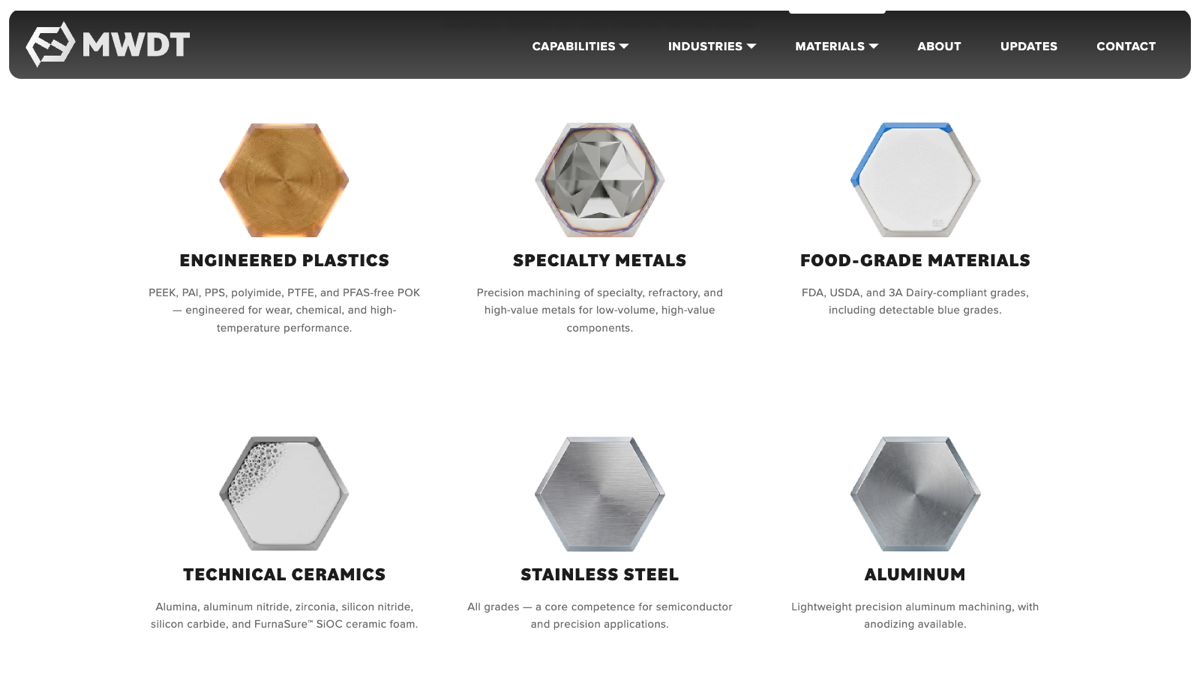
The Materials collection: every tile is a hexagon, a direct callback to the MWDT emblem.
Phase 5: A Homepage That Earns One “Ooh” — Then Gets Out of the Way
Manufacturers rarely have product photography, and MWDT was no exception. Rather than fall back on stock icons, I generated a library of representative components — a machined manifold, a turbine wheel, an injection-molded ceramic part, downhole tooling — rendered in a consistent style and handed the full set to the client for future use.
The manifold became the centerpiece. I extracted a 90-frame rotation sequence and bound it to scroll with GSAP ScrollTrigger: as you move down the page, the part rotates and eases along with you, settling beside the capabilities section. It’s cinematic exactly once, then the page becomes a fast, scannable spec sheet.
“This homepage really draws you in.”
— Chris Charles, Co-Owner, MWD Technologies
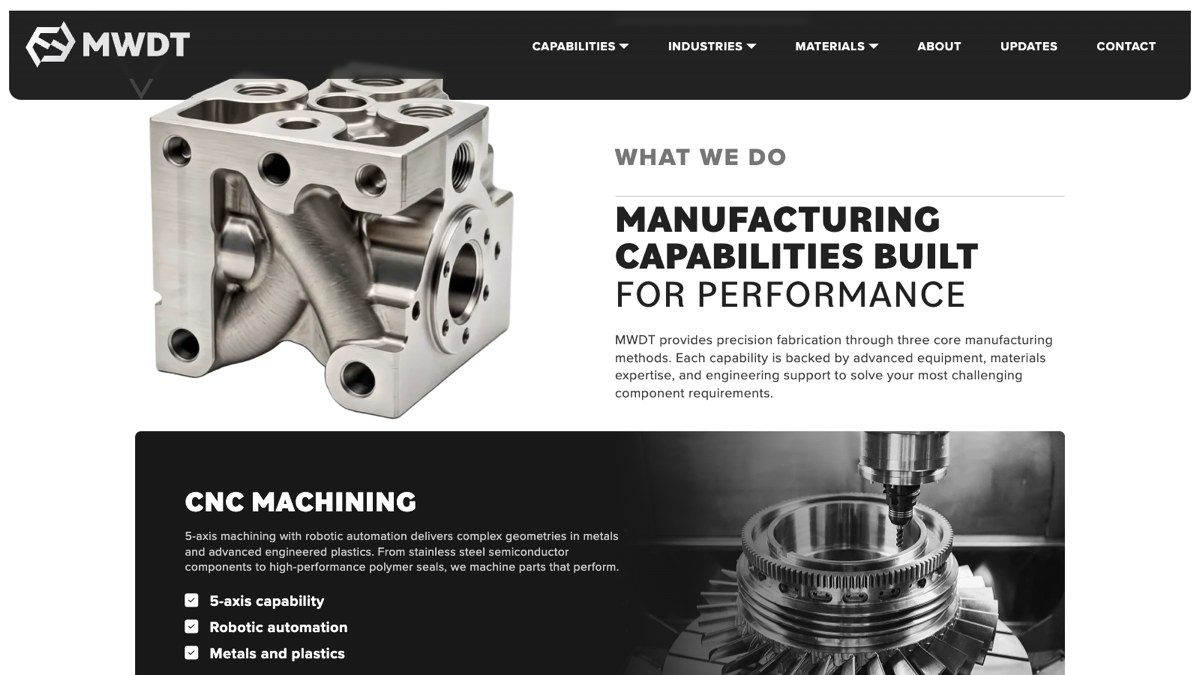
The scroll-driven manifold settles into place beside the capabilities section — one moment of motion, then straight into substance.
The client’s one direction on the interior mockups — keep the industry imagery vibrant and full-color rather than pure black and white — set the tone for the detail pages: a monochrome, high-contrast frame with rich color where the work itself appears.
Phase 6: Content That Speaks Engineer
Client-supplied content covered the core services well, but eleven industries and nine materials left gaps. I wrote and structured all 29 subpages, filling the gaps with keyword and competitive research grounded to what MWDT actually does — grade and alloy breakdowns, PFAS-free and detectable-grade differentiators, application-specific part types — while deliberately avoiding unverifiable claims like certifications or tolerances the client hadn’t confirmed.
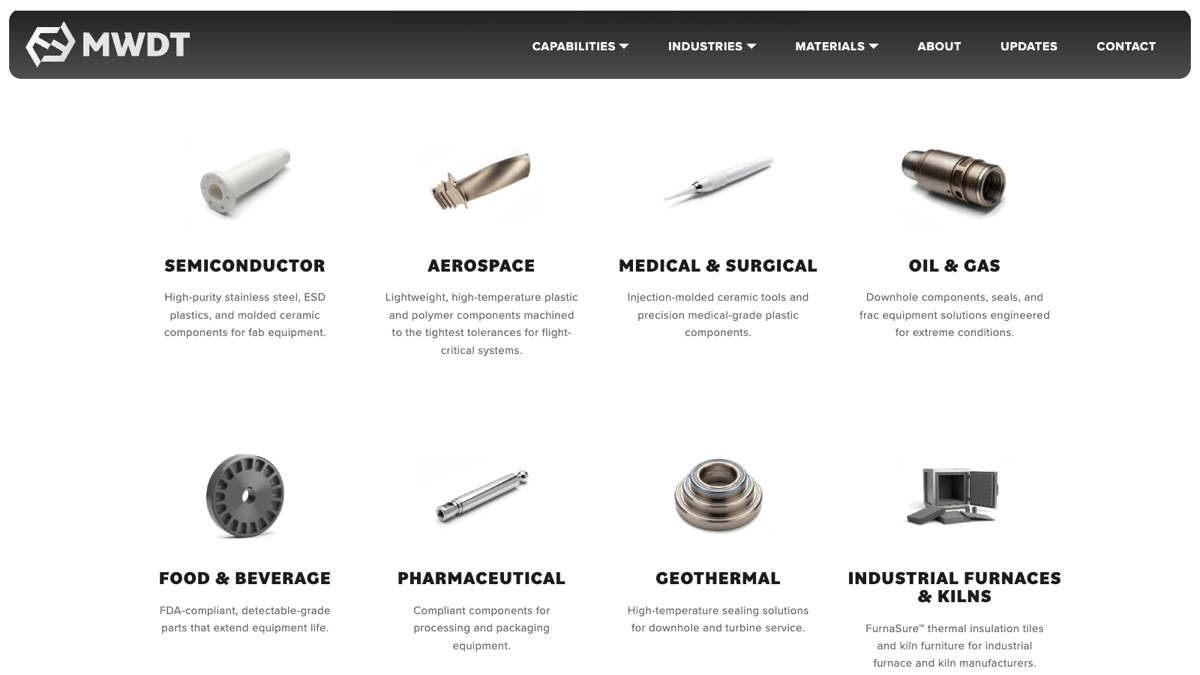
Eight featured industries on the homepage, each with its own rendered component — and each managed as a CMS entry the client can add to.
Phase 7: Development the Client Owns
The site runs on Hugo, deployed to Netlify’s global CDN, with the codebase in GitHub and Decap CMS for editing. Capabilities, industries, and materials are true content collections: add an entry, upload an image, and the new detail page, its card on the list page, and its slide in the hero marquee all appear automatically — styled, animated, and indexed.
“Oh, wow, that’s amazing.”
— Chris Charles, Co-Owner, MWD Technologies, on adding new products without calling a developer
The Results: A Brand, a Sales Engine, and a Platform Built to Grow
The new mwdtinc.com launched on September 5, 2026, replacing the stop-gap landing page that had carried the fuel cell campaign since February.
✅ From zero to a full digital presence: a brand mark, a sister-brand mark, and 29 pages that position MWDT as a single-source partner across eleven industries.
✅ Marketing that didn’t wait: the fuel cell landing page, email infrastructure, and outreach campaign shipped seven months before the full site — and the full site launched on the same domain.
✅ Growth without a developer: every new industry, material, or capability is a CMS entry, not a change order.
✅ A homepage engineers remember: a scroll-driven 3D rotating part and animated logo mark, on a page that still loads as a fast static site.
✅ A client who’d rather do it right: the project ran at the pace the content needed, and Chris said so.
“We’re really excited about what you’re doing. It looks really good. This homepage really draws you in.”
“You’re doing a great job. We’d rather take the time we need and get it right like you’re doing, rather than rush through it.”
— Chris Charles, Co-Owner, MWD Technologies
Frequently Asked Questions
Why build a landing page before the full website?
MWDT had an outreach campaign ready to send and nowhere to send it. A stop-gap landing page in the new brand direction, launched on the production domain with proper email and form infrastructure, let the campaign run months ahead of the full site — and everything it generated carried straight over at launch.
What platform is the MWDT website built on?
Hugo (JAMstack) deployed to Netlify’s global CDN, with Decap CMS for content editing, GitHub version control, GSAP ScrollTrigger for the scroll-driven animations, and Basin for segmented form routing. No plugins, no database, nothing to patch.
Can the MWDT team add new industries or materials themselves?
Yes. Capabilities, industries, and materials are content collections managed in the CMS. Adding an entry automatically generates the detail page, the list-page card, and the hero marquee slide — no developer involved.
Did the project include brand identity?
Yes. The engagement began with logo exploration for the abbreviated MWDT mark, followed by email signature templates and a cohesive sister-brand mark for the owners’ metal finishing company. The hexagonal emblem then drove the site’s design language.
Is Your Business Invisible to the Buyers Who Check First?
If your reputation lives in relationships and spec sheets but not online — or you need marketing to move before the full site can — let’s talk about building a brand and platform that grows one page at a time.